Informing Consent
  • Home
  • Calling the Shots
  • Learning library
  • Talk to your doctor
  • Covid
  • Family health
  • Caring through vaccines
  • A closer look
  • Cancelled
  • Contact
  • Donate
  • More
    • Home
    • Calling the Shots
    • Learning library
    • Talk to your doctor
    • Covid
    • Family health
    • Caring through vaccines
    • A closer look
    • Cancelled
    • Contact
    • Donate
Informing Consent
  • Home
  • Calling the Shots
  • Learning library
  • Talk to your doctor
  • Covid
  • Family health
  • Caring through vaccines
  • A closer look
  • Cancelled
  • Contact
  • Donate

Vaccine scepticism – not just a recent phenomenon

Governments and health authorities around the world loudly promote the benefits of vaccines. 


The general public is assured that vaccines: 

  • are safe and effective 
  • prevent disease 
  • have totally eradicated some diseases worldwide (e.g. smallpox) 
  • should be given to the vast majority of the population, especially children 
  • are an essential tool for reaching herd immunity against certain diseases 
  • should often be mandated as part of the overall vaccine strategy 


The impression given is that we should all be united in our support for vaccines. 


But, alongside the above claims, come the counter-claims of people who choose not to vaccinate themselves or their children. Health authorities and the media often portray this as a selfish, uneducated, unscientific, ill-advised and possibly dangerous decision.  


Consider this message from 2021, to people who chose not to take the Covid vaccine. 


Vaccine scepticism, however, is not a recent development. In fact, it has existed for almost as long as vaccines themselves. 
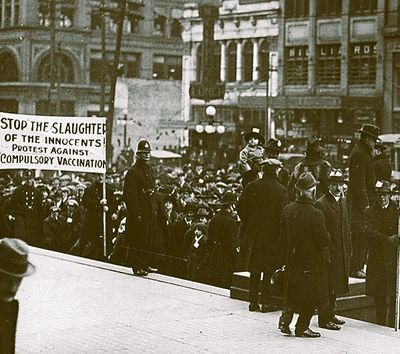
Old photo of protest

Are vaccines alone really what saved us?

Perhaps not. 


Better sanitation and public health measures have had an enormous impact on the reduction of disease. 


‘Contaminated water and lack of sanitation lead to the transmission of pathogens through feces and, to a lesser extent, urine.’ 

Source: Injury Prevention and Environmental Health. 3rd edition 


Data from socio-economic sources also show that serious harm from many of these diseases were already in decline, before vaccines were deployed.  


Numerous examples have been compiled by Dr Suzanne Humphries, including: 

Graph

 England and Wales measles mortality rate from 1838 to 1978.

Graph

United States whooping cough mortality rate from 1920 to 1985. 

Vaccine hesitancy in the 1800s

As far back as the 1800s, doctors were speaking out about their concerns over vaccination. 


In 1818, the Scottish surgeon Thomas Brown – until then an advocate for smallpox vaccines – had a change of heart: 


‘The accounts from all quarters of the world, wherever vaccination has been introduced ... the cases of failures are now increased to an alarming proportion.’ 


The book ‘Dissolving Illusions’, by Dr Suzanne Humphries and Roman Bystrianyk, covers in fascinating detail the early (and now largely forgotten) controversy around vaccination. They note: ‘Surgeons and doctors were paid well to perform vaccination and embraced it as a new form of income’. 


The general public did not always fall easily into line. For example, few of us know that, on March 23, 1885, thousands of people gathered in Leicester, UK, to protest against government-enforced smallpox vaccination. 


Rightly or wrongly, over time, the voices of those supporting vaccination have largely drowned out the voices of those raising questions and concerns. 

The cost of questioning vaccination

Person standing alone in field


In 1998 Dr Andrew Wakefield, along with fellow researchers, questioned the Measles, Mumps and Rubella Vaccine (MMR) and its possible connection to autism and bowel disease in children. 


He requested that more research be undertaken to investigate this possible link.  


This does not seem unreasonable – surely it’s better to be safe than sorry when our children’s health is at stake. 


However, in 1998, his paper caused much disquiet which played out in the media, with calls for him to be prevented from practising medicine. He was duly removed from the medical register by the GMC.  


Scientific journals were also eager to denounce his claims. 


Wakefield’s name has now become synonymous with fraudulent science. This response to his research no doubt contributed to the silencing of any discussion or debate on the possible side effects and harms of vaccinating children in the ensuing years.  


Here is an alternative view, with more information on the Wakefield story. 


Wakefield is not alone – other doctors who have been smeared and discredited for raising questions around vaccines include Dr Suzanne Humphries, Dr Jayne Donegan, Dr Paul Thomas and many more.


Find out more about these cancelled doctors here. 

Covid-19 – a trigger for mistrust?

The social contract between the pharmaceutical industry, public health bodies and parents has been challenged over the past few years. The rollout of the Covid-19 vaccine, in particular, has damaged the trust that many parents once had in these institutions.  


Some of the distrust stems from: 


  • The speed at which these vaccines were manufactured and brought to market. 
  • The strident claim that they were both safe and effective, when there was no long-term data to prove either of those claims. 
  • Unequivocal approval for every citizen (adult and child) to receive a vaccine, when there was insufficient clinical trial data to warrant that. 
  • Early, and then continuing, reports on official government websites (such as the Yellow Card system in the UK and VAERS in America) that detailed serious and unexpected side-effects. 
  • Very disturbing media reports of serious vaccine harms. 


Parents of younger children in the UK were sufficiently sceptical about the need for Covid-19 jabs for their children that only 10% of 5-11-year-olds received the injection.  


We are now witnessing more general vaccine hesitancy on an unprecedented scale, perhaps as a result of the public distrust in pharmaceutical companies since Covid-19. 


We discuss the Covid-19 vaccines in more detail here.

What about the other vaccines?

Child in field

Concerns about the Covid-19 vaccine have caused many doctors, scientists, politicians and the general public to ask questions about the vaccine industry in general.  


There are calls for a retrospective examination of how all vaccines are tested for safety and efficacy – particularly those administered to children as part of the traditional vaccination schedule.  


After all, some temporary side-effects for somebody in their 80s may be acceptable in terms of the risk-benefit of disease versus vaccination. But a child has their whole life ahead of them, and the risk of side effects that are more than just mild and temporary – and which could be life-changing – may not be acceptable.  

How are vaccines tested for safety and efficacy?

Concerns about vaccine safety include:

  • The increase in vaccine doses recommended over the past few decades.  
  • The increase in chronic illnesses, which correlates with that increase.  
  • Health conditions listed as side effects of those vaccines.  
  • A lack of true placebos in clinical trials. 
  • Health differences between vaccinated and unvaccinated children.  
  • Newborns being exposed to aluminium in vaccines. 
  • The temporal correlation between vaccine introductions and autoimmune illnesses in children. 
  • The crimes of vaccine manufacturers. 
  • A lack of accountability for vaccine safety.  

Test tubes

The missing placebos

Many of us assume, understandably, that all vaccines are thoroughly tested against true placebos (for example, saline water). 


This appears not to be the case.


This chart from ICAN claims that none of the vaccine doses the CDC recommends for routine injection into US children were licensed by the FDA based on a long-term placebo-controlled trial. 


What about the UK?


The following Freedom of Information Request was sent to the MHRA in June 2023: 


‘I would like to request copies of any inert placebo-controlled clinical trials for the current vaccines on the children's recommended vaccine schedule please.’ 


The MHRA’s response was that ‘the information you have requested is already in the public domain, and can be found at https://www.clinicaltrialsregister.eu/ctr-search/search '


Links to UK trials related to vaccines were included in their full response. 


Taking one of these trials - ‘Immunogenicity and reactogenicity of concomitantly administered hexavalent and Group B meningococcal vaccines in infancy’ - as an example, we can see that 194 subjects were split into 2 groups, and both groups were given a number of different vaccines. (The trial also reports that over 8% of participants suffered serious adverse events.) 


The use of true placebos – or not – in vaccine trials is something that we at Informing Consent plan to research further, and we will share what we find.  


It might be reasonable to assume, however, that the same companies make the same vaccines for worldwide distribution – so the data behind US vaccines would therefore be the same as or similar to the data behind UK vaccines. 


Parents and carers are entitled to ask their doctors for more information on vaccine trials and placebos. We encourage discourse between doctors and patients – find out more about how you might approach this here.  


You can also dig deeper with the resources in our Learning Library.


More broadly around the world, a committee of the World Health Organization makes recommendations for biological products used internationally. Many countries have adopted the WHO standards, and others have standards similar to those of the United States. Countries that lack the infrastructure to monitor drug and vaccine safety will often defer to WHO, FDA or European recommendations. 

Absolute and Relative Risk – do you know the difference?

When considering a medical procedure, most of us want to know the potential risks versus the expected benefits. This is a critical part of the decision to give (or withhold) consent. 


However, risk can be presented in two ways: Absolute Risk and Relative Risk. Understanding the difference is essential. 


We can present the same risk as 50% or just 1%, depending on how the data is calculated. Professor Norman Fenton gives a clear explanation in this short video.   


Another example is the Pfizer Covid vaccine trial data, which showed it to be both 95% and 0.7% effective – depending on how you looked at the data. This 2021 explainer from Safer to Wait shows how that was possible (see below). 


Medical practitioners should know the difference between Absolute and Relative Risk – but you may want to check this during any discussions. When people start talking in percentages, make sure you ask to see the actual numbers involved. 

95 or 0.7 (pdf)

Download

What now?

Vaccines have been put under a spotlight, and the very concept of vaccination is now being questioned by many. (For some, there are further questions to be asked about virology and contagion, but that is not our focus at Informing Consent.)   


The team at Informing Consent is digging deeper into each of the childhood vaccines – one at a time. We'll share what we find, such as:


  • the health conditions that vaccines have been produced for 
  • vaccine ingredients – what exactly is in each vaccine vial? 
  • patient information leaflets 
  • vaccine trials and their results 
  • data on safety and efficacy 


Plus anything else that we think is relevant to informed consent. 

Magnifying glass

But first...

Childhood illness: when should I worry?

Listen to this conversation between a mum of young twins, a retired paediatrician and a practising GP. 


It gives sensible, practical advice about how to care for unwell children – and when to seek further help.  

Your Child: Your Choice

Page last reviewed: June 2026

Please note: this website is for information only. It is not a replacement for advice from your primary healthcare provider, and it is not legal advice. 


Please consult your healthcare provider before making any changes to medication, diet or lifestyle.


The views of the individuals featured on this website are not necessarily the views of Informing Consent. However, we are united in our efforts to protect children's health.      


Copyright © 2026 Informing Consent - All Rights Reserved.

  • Privacy Policy
  • Calling the Shots
  • Learning library
  • Talk to your doctor
  • Covid
  • Family health
  • Caring through vaccines
  • A closer look
  • Cancelled
  • Contact
  • Donate

This website uses cookies.

We use cookies to analyze website traffic and optimize your website experience. By accepting our use of cookies, your data will be aggregated with all other user data.

DeclineAccept